All ignited Minds are welcome here...!!!

Please come and Support us in Making this world a better place to live.

Friday, February 28, 2020

The Nobel Prize in Physiology or Medicine 2019

Press release: The Nobel Prize in Physiology or Medicine 2019

English

Nobel Assembly logo

Press release

2019-10-07
has today decided to award

the 2019 Nobel Prize in Physiology or Medicine
jointly to
William G. Kaelin Jr., Sir Peter J. Ratcliffe and Gregg L. Semenza
for their discoveries of how cells sense and adapt to oxygen availability

SUMMARY

Animals need oxygen for the conversion of food into useful energy. The fundamental importance of oxygen has been understood for centuries, but how cells adapt to changes in levels of oxygen has long been unknown.
William G. Kaelin Jr., Sir Peter J. Ratcliffe and Gregg L. Semenza discovered how cells can sense and adapt to changing oxygen availability. They identified molecular machinery that regulates the activity of genes in response to varying levels of oxygen.
The seminal discoveries by this year’s Nobel Laureates revealed the mechanism for one of life’s most essential adaptive processes. They established the basis for our understanding of how oxygen levels affect cellular metabolism and physiological function. Their discoveries have also paved the way for promising new strategies to fight anemia, cancer and many other diseases.

Oxygen at center stage

Oxygen, with the formula O2, makes up about one fifth of Earth’s atmosphere. Oxygen is essential for animal life: it is used by the mitochondria present in virtually all animal cells in order to convert food into useful energy. Otto Warburg, the recipient of the 1931 Nobel Prize in Physiology or Medicine, revealed that this conversion is an enzymatic process.
During evolution, mechanisms developed to ensure a sufficient supply of oxygen to tissues and cells. The carotid body, adjacent to large blood vessels on both sides of the neck, contains specialized cells that sense the blood’s oxygen levels. The 1938 Nobel Prize in Physiology or Medicine to Corneille Heymans awarded discoveries showing how blood oxygen sensing via the carotid body controls our respiratory rate by communicating directly with the brain.

HIF enters the scene

In addition to the carotid body-controlled rapid adaptation to low oxygen levels (hypoxia), there are other fundamental physiological adaptations. A key physiological response to hypoxia is the rise in levels of the hormone erythropoietin (EPO), which leads to increased production of red blood cells (erythropoiesis). The importance of hormonal control of erythropoiesis was already known at the beginning of the 20th century, but how this process was itself controlled by O2 remained a mystery.
Gregg Semenza studied the EPO gene and how it is regulated by varying oxygen levels. By using gene-modified mice, specific DNA segments located next to the EPO gene were shown to mediate the response to hypoxia. Sir Peter Ratcliffe also studied O2-dependent regulation of the EPO gene, and both research groups found that the oxygen sensing mechanism was present in virtually all tissues, not only in the kidney cells where EPO is normally produced. These were important findings showing that the mechanism was general and functional in many different cell types.
Semenza wished to identify the cellular components mediating this response. In cultured liver cells he discovered a protein complex that binds to the identified DNA segment in an oxygen-dependent manner. He called this complex the hypoxia-inducible factor (HIF) . Extensive efforts to purify the HIF complex began, and in 1995, Semenza was able to publish some of his key findings, including identification of the genes encoding HIF. HIF was found to consist of two different DNA-binding proteins, so called transcription factors, now named HIF-1α and ARNT. Now the researchers could begin solving the puzzle, allowing them to understand which additional components were involved and how the machinery works.

VHL: an unexpected partner

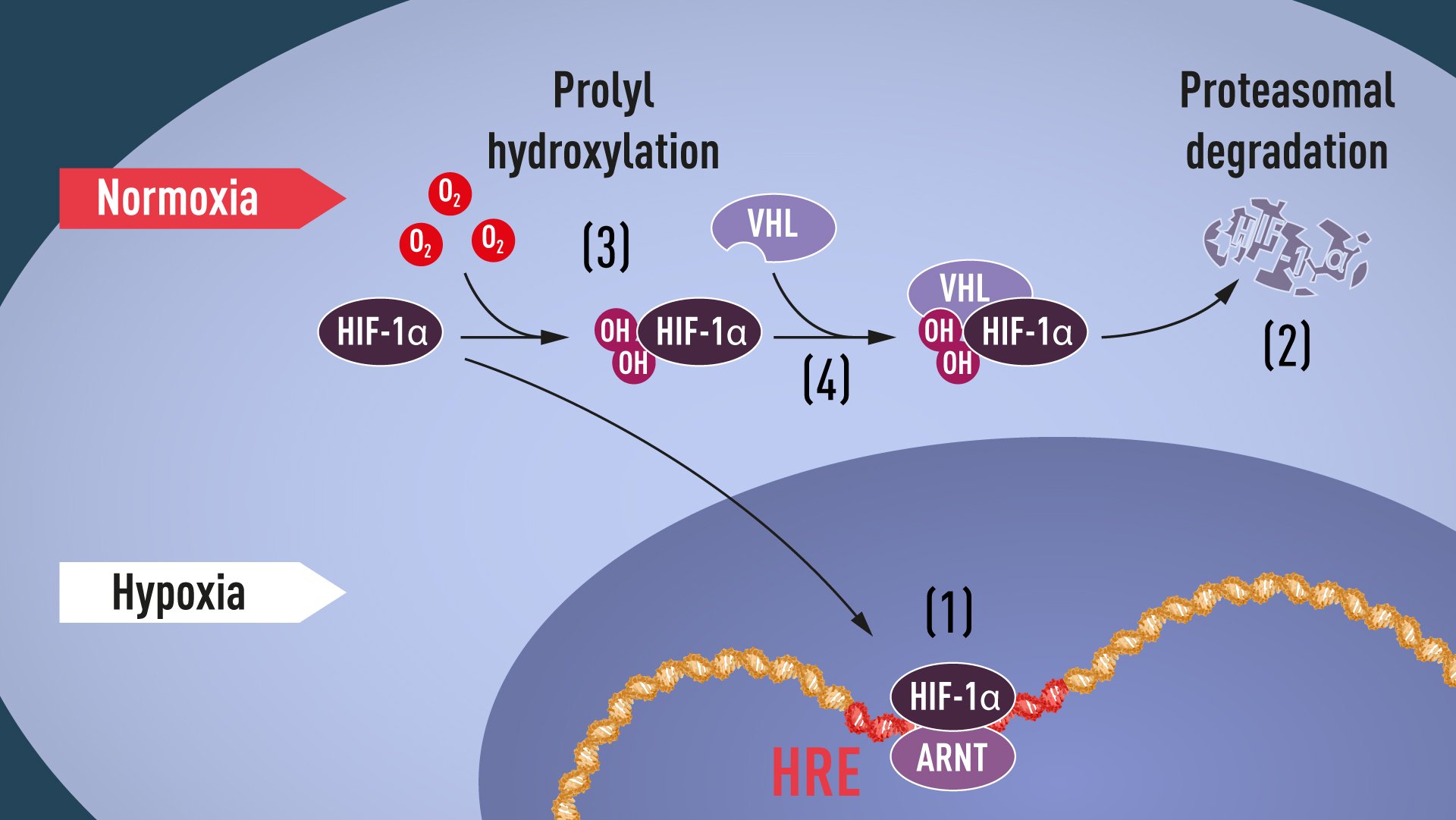
When oxygen levels are high, cells contain very little HIF-1α. However, when oxygen levels are low, the amount of HIF-1α increases so that it can bind to and thus regulate the EPO gene as well as other genes with HIF-binding DNA segments (Figure 1). Several research groups showed that HIF-1α, which is normally rapidly degraded, is protected from degradation in hypoxia. At normal oxygen levels, a cellular machine called the proteasome, recognized by the 2004 Nobel Prize in Chemistry to Aaron CiechanoverAvram Hershko and Irwin Rose, degrades HIF-1α. Under such conditions a small peptide, ubiquitin, is added to the HIF-1α protein. Ubiquitin functions as a tag for proteins destined for degradation in the proteasome. How ubiquitin binds to HIF-1α in an oxygen-dependent manner remained a central question.
The answer came from an unexpected direction. At about the same time as Semenza and Ratcliffe were exploring the regulation of the EPO gene, cancer researcher William Kaelin, Jr. was researching an inherited syndrome, von Hippel-Lindau’s disease (VHL disease). This genetic disease leads to dramatically increased risk of certain cancers in families with inherited VHL mutations. Kaelin showed that the VHL gene encodes a protein that prevents the onset of cancer. Kaelin also showed that cancer cells lacking a functional VHL gene express abnormally high levels of hypoxia-regulated genes; but that when the VHL gene was reintroduced into cancer cells, normal levels were restored. This was an important clue showing that VHL was somehow involved in controlling responses to hypoxia. Additional clues came from several research groups showing that VHL is part of a complex that labels proteins with ubiquitin, marking them for degradation in the proteasome. Ratcliffe and his research group then made a key discovery: demonstrating that VHL can physically interact with HIF-1α and is required for its degradation at normal oxygen levels. This conclusively linked VHL to HIF-1α.

Oxygen sHIFts the balance

Many pieces had fallen into place, but what was still lacking was an understanding of how O2 levels regulate the interaction between VHL and HIF-1α. The search focused on a specific portion of the HIF-1α protein known to be important for VHL-dependent degradation, and both Kaelin and Ratcliffe suspected that the key to O2-sensing resided somewhere in this protein domain. In 2001, in two simultaneously published articles they showed that under normal oxygen levels, hydroxyl groups are added at two specific positions in HIF-1α (Figure 1). This protein modification, called prolyl hydroxylation, allows VHL to recognize and bind to HIF-1α and thus explained how normal oxygen levels control rapid HIF-1α degradation with the help of oxygen-sensitive enzymes (so-called prolyl hydroxylases). Further research by Ratcliffe and others identified the responsible prolyl hydroxylases. It was also shown that the gene activating function of HIF-1α was regulated by oxygen-dependent hydroxylation. The Nobel Laureates had now elucidated the oxygen sensing mechanism and had shown how it works.
Oxygen levels
Figure 1. When oxygen levels are low (hypoxia), HIF-1α is protected from degradation and accumulates in the nucleus, where it associates with ARNT and binds to specific DNA sequences (HRE) in hypoxia-regulated genes (1). At normal oxygen levels, HIF-1α is rapidly degraded by the proteasome (2). Oxygen regulates the degradation process by the addition of hydroxyl groups (OH) to HIF-1α (3). The VHL protein can then recognize and form a complex with HIF-1α leading to its degradation in an oxygen-dependent manner (4).

Oxygen shapes physiology and pathology

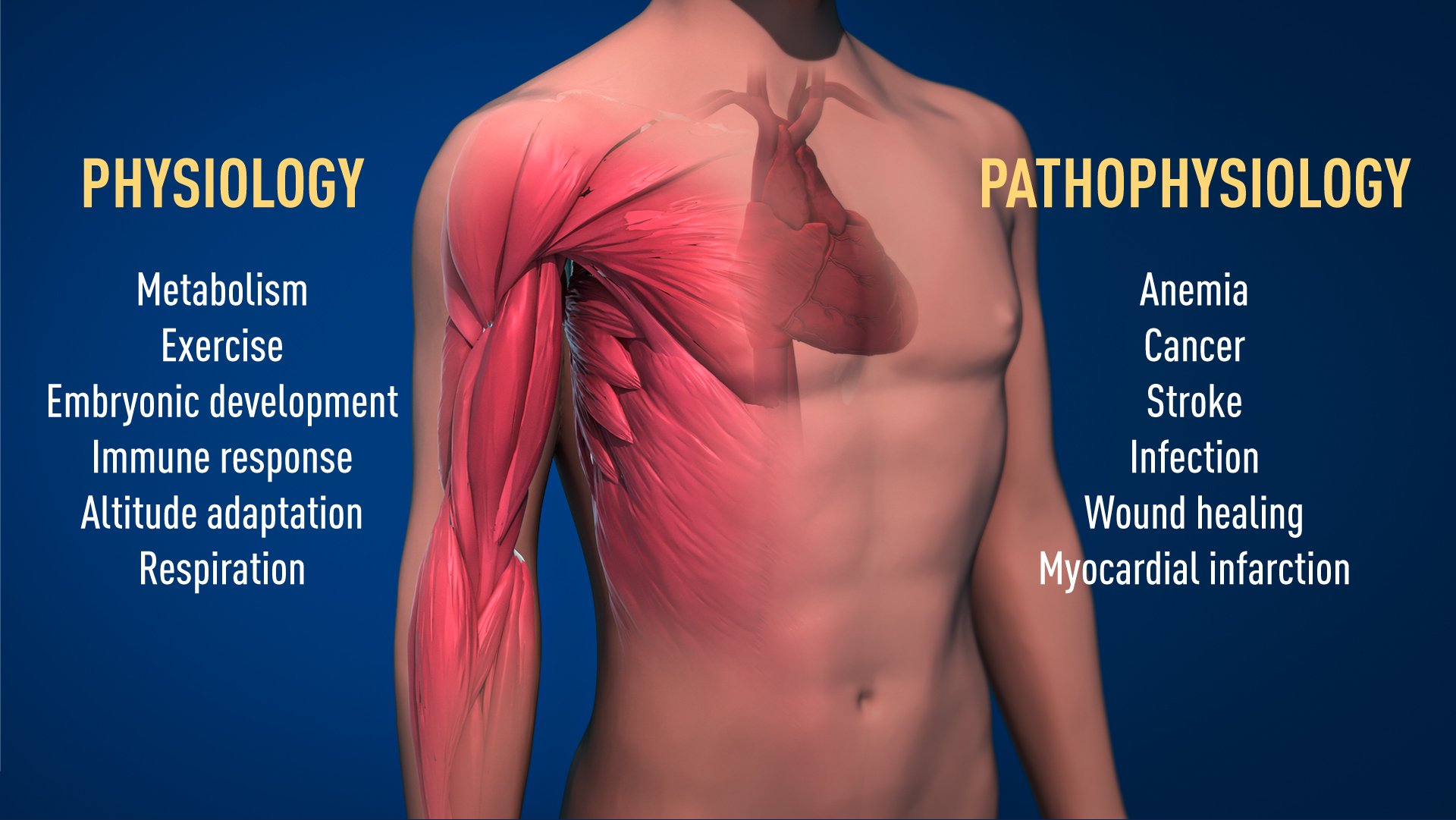
Thanks to the groundbreaking work of these Nobel Laureates, we know much more about how different oxygen levels regulate fundamental physiological processes. Oxygen sensing allows cells to adapt their metabolism to low oxygen levels: for example, in our muscles during intense exercise. Other examples of adaptive processes controlled by oxygen sensing include the generation of new blood vessels and the production of red blood cells. Our immune system and many other physiological functions are also fine-tuned by the O2-sensing machinery. Oxygen sensing has even been shown to be essential during fetal development for controlling normal blood vessel formation and placenta development.
Oxygen sensing is central to a large number of diseases (Figure 2). For example, patients with chronic renal failure often suffer from severe anemia due to decreased EPO expression. EPO is produced by cells in the kidney and is essential for controlling the formation of red blood cells, as explained above. Moreover, the oxygen-regulated machinery has an important role in cancer. In tumors, the oxygen-regulated machinery is utilized to stimulate blood vessel formation and reshape metabolism for effective proliferation of cancer cells. Intense ongoing efforts in academic laboratories and pharmaceutical companies are now focused on developing drugs that can interfere with different disease states by either activating, or blocking, the oxygen-sensing machinery.
Pathological processes
Figure 2. The awarded mechanism for oxygen sensing has fundamental importance in physiology, for example for our metabolism, immune response and ability to adapt to exercise. Many pathological processes are also affected. Intensive efforts are ongoing to develop new drugs that can either inhibit or activate the oxygen-regulated machinery for treatment of anemia, cancer and other diseases.

Key publications

Semenza, G.L, Nejfelt, M.K., Chi, S.M. & Antonarakis, S.E. (1991). Hypoxia-inducible nuclear factors bind to an enhancer element located 3’ to the human erythropoietin gene. Proc Natl Acad Sci USA88, 5680-5684
Wang, G.L., Jiang, B.-H., Rue, E.A. & Semenza, G.L. (1995). Hypoxia-inducible factor 1 is a basic-helix-loop-helix-PAS heterodimer regulated by cellular O2 tension.  Proc Natl Acad Sci USA, 92, 5510-5514
Maxwell, P.H., Wiesener, M.S., Chang, G.-W., Clifford, S.C., Vaux, E.C., Cockman, M.E., Wykoff, C.C., Pugh, C.W., Maher, E.R. & Ratcliffe, P.J. (1999). The tumour suppressor protein VHL targets hypoxia-inducible factors for oxygen-dependent proteolysis. Nature, 399, 271-275
Ivan, M., Kondo, K., Yang, H., Kim, W., Valiando, J., Ohh, M., Salic, A., Asara, J.M., Lane, W.S. & Kaelin Jr., W.G. (2001) HIFa targeted for VHL-mediated destruction by proline hydroxylation: Implications for O2 sensing. Science, 292, 464-468
Jaakkola, P., Mole, D.R., Tian, Y.-M., Wilson, M.I., Gielbert, J., Gaskell, S.J., von Kriegsheim, A., Heberstreit, H.F., Mukherji, M., Schofield, C.J., Maxwell, P.H., Pugh, C.W. & Ratcliffe, P.J. (2001). Targeting of HIF-α to the von Hippel-Lindau ubiquitylation complex by O2-regulated prolyl hydroxylation. Science, 292, 468-472

William G. Kaelin, Jr. was born in 1957 in New York. He obtained an M.D. from Duke University, Durham. He did his specialist training in internal medicine and oncology at Johns Hopkins University, Baltimore, and at the Dana-Farber Cancer Institute, Boston. He established his own research lab at the Dana-Farber Cancer Institute and became a full professor at Harvard Medical School in 2002. He is an Investigator of the Howard Hughes Medical Institute since 1998.
Sir Peter J. Ratcliffe was born in 1954 in Lancashire, United Kingdom. He studied medicine at Gonville and Caius College at Cambridge University and did his specialist training in nephrology at Oxford. He established an independent research group at Oxford University and became a full professor in 1996. He is the Director of Clinical Research at Francis Crick Institute, London, Director for Target Discovery Institute in Oxford and Member of the Ludwig Institute for Cancer Research.
Gregg L. Semenza was born in 1956 in New York. He obtained his B.A. in Biology from Harvard University, Boston. He received an MD/PhD degree from the University of Pennsylvania, School of Medicine, Philadelphia in 1984 and trained as a specialist in pediatrics at Duke University, Durham. He did postdoctoral training at Johns Hopkins University, Baltimore where he also established an independent research group. He became a full professor at the Johns Hopkins University in 1999 and since 2003 is the Director of the Vascular Research Program at the Johns Hopkins Institute for Cell Engineering.

Illustrations: © The Nobel Committee for Physiology or Medicine. Illustrator: Mattias Karlén

The Nobel Assembly, consisting of 50 professors at Karolinska Institutet, awards the Nobel Prize in Physiology or Medicine. Its Nobel Committee evaluates the nominations. Since 1901 the Nobel Prize has been awarded to scientists who have made the most important discoveries for the benefit of humankind.
Nobel Prize® is the registered trademark of the Nobel Foundation
To cite this section
MLA style: Press release: The Nobel Prize in Physiology or Medicine 2019. NobelPrize.org. Nobel Media AB 2020. Fri. 28 Feb 2020.

The Nobel Prize in Chemistry 2019

Press release: The Nobel Prize in Chemistry 2019

English
Logo
9 October 2019
The Royal Swedish Academy of Sciences has decided to award the Nobel Prize in Chemistry 2019 to
John B. Goodenough
The University of Texas at Austin, USA

M. Stanley Whittingham
Binghamton University, State University of New York, USA

Akira Yoshino
Asahi Kasei Corporation, Tokyo, Japan
Meijo University, Nagoya, Japan

“for the development of lithium-ion batteries”

They created a rechargeable world

The Nobel Prize in Chemistry 2019 rewards the development of the lithium-ion battery. This lightweight, rechargeable and powerful battery is now used in everything from mobile phones to laptops and electric vehicles. It can also store significant amounts of energy from solar and wind power, making possible a fossil fuel-free society.
Lithium-ion batteries are used globally to power the portable electronics that we use to communicate, work, study, listen to music and search for knowledge. Lithiumion batteries have also enabled the development of long-range electric cars and the storage of energy from renewable sources, such as solar and wind power.
The foundation of the lithium-ion battery was laid during the oil crisis in the 1970s. Stanley Whittingham worked on developing methods that could lead to fossil fuel-free energy technologies. He started to research superconductors and discovered an extremely energy-rich material, which he used to create an innovative cathode in a lithium battery. This was made from titanium disulphide which, at a molecular level, has spaces that can house – intercalate – lithium ions.
The battery’s anode was partially made from metallic lithium, which has a strong drive to release electrons. This resulted in a battery that literally had great potential, just over two volts. However, metallic lithium is reactive and the battery was too explosive to be viable.
John Goodenough predicted that the cathode would have even greater potential if it was made using a metal oxide instead of a metal sulphide. After a systematic search, in 1980 he demonstrated that cobalt oxide with intercalated lithium ions can produce as much as four volts. This was an important breakthrough and would lead to much more powerful batteries.
With Goodenough’s cathode as a basis, Akira Yoshino created the first commercially viable lithium-ion battery in 1985. Rather than using reactive lithium in the anode, he used petroleum coke, a carbon material that, like the cathode’s cobalt oxide, can intercalate lithium ions.
The result was a lightweight, hardwearing battery that could be charged hundreds of times before its performance deteriorated. The advantage of lithium-ion batteries is that they are not based upon chemical reactions that break down the electrodes, but upon lithium ions flowing back and forth between the anode and cathode.
Lithium-ion batteries have revolutionised our lives since they first entered the market in 1991. They have laid the foundation of a wireless, fossil fuel-free society, and are of the greatest benefit to humankind.

Illustrations

The illustrations are free to use for non-commercial purposes. Attribute ”© Johan Jarnestad/The Royal Swedish Academy of Sciences”

Read more about this year’s prize


John B. Goodenough, born 1922 in Jena, Germany.  Ph.D. 1952 from the University of Chicago, USA. Virginia H.  Cockrell Chair in Engineering at The University of Texas at Austin, USA.
M. Stanley Whittingham, born 1941 in the UK. Ph.D.  1968 from Oxford University, UK. Distinguished Professor at Binghamton University, State University of New York, USA.
Akira Yoshino, born 1948 in Suita, Japan.  Ph.D. 2005 from Osaka University, Japan. Honorary Fellow at Asahi Kasei Corporation, Tokyo, Japan and professor at Meijo University, Nagoya, Japan.

Prize amount: 9 million Swedish krona, to be shared equally between the Laureates.
Further information: www.kva.se and http://www.nobelprize.org
Press contact: Eva Nevelius, Press Secretary, +46 8 673 95 44, +46 70 878 67 63, eva.nevelius@kva.se
Expert: Olof Ramström, member of the Nobel Committee for Chemistry, +46 70 433 42 60, ramstrom@protonmail.com


The Royal Swedish Academy of Sciences, founded in 1739, is an independent organisation whose overall objective is to promote the sciences and strengthen their influence in society. The Academy takes special responsibility for the natural sciences and mathematics, but endeavours to promote the exchange of ideas between various disciplines.
Nobel Prize® is a registered trademark of the Nobel Foundation.
To cite this section
MLA style: Press release: The Nobel Prize in Chemistry 2019. NobelPrize.org. Nobel Media AB 2020. Fri. 28 Feb 2020.

The Nobel Prize in Physics 2019

Press release: The Nobel Prize in Physics 2019

English
Logo
8 October 2019
The Royal Swedish Academy of Sciences has decided to award the Nobel Prize in Physics 2019
“for contributions to our understanding of the evolution of the universe and Earth’s place in the cosmos”
with one half to
James Peebles
Princeton University, USA

“for theoretical discoveries in physical cosmology”
and the other half jointly to
Michel Mayor
University of Geneva, Switzerland

and
Didier Queloz
University of Geneva, Switzerland
University of Cambridge, UK

“for the discovery of an exoplanet orbiting a solar-type star”

New perspectives on our place in the universe

This year’s Nobel Prize in Physics rewards new understanding of the universe’s structure and history, and the first discovery of a planet orbiting a solar-type star outside our solar system.
James Peebles’ insights into physical cosmology have enriched the entire field of research and laid a foundation for the transformation of cosmology over the last fifty years, from speculation to science. His theoretical framework, developed since the mid-1960s, is the basis of our contemporary ideas about the universe.
The Big Bang model describes the universe from its very first moments, almost 14 billion years ago, when it was extremely hot and dense. Since then, the universe has been expanding, becoming larger and colder. Barely 400,000 years after the Big Bang, the universe became transparent and light rays were able to travel through space. Even today, this ancient radiation is all around us and, coded into it, many of the universe’s secrets are hiding. Using his theoretical tools and calculations, James Peebles was able to interpret these traces from the infancy of the universe and discover new physical processes.
The results showed us a universe in which just five per cent of its content is known, the matter which constitutes stars, planets, trees – and us. The rest, 95 per cent, is unknown dark matter and dark energy. This is a mystery and a challenge to modern physics.
In October 1995, Michel Mayor and Didier Queloz announced the first discovery of a planet outside our solar system, an exoplanet, orbiting a solar-type star in our home galaxy, the Milky Way. At the Haute-Provence Observatory in southern France, using custom-made instruments, they were able to see planet 51 Pegasi b, a gaseous ball comparable with the solar system’s biggest gas giant, Jupiter.
This discovery started a revolution in astronomy and over 4,000 exoplanets have since been found in the Milky Way. Strange new worlds are still being discovered, with an incredible wealth of sizes, forms and orbits. They challenge our preconceived ideas about planetary systems and are forcing scientists to revise their theories of the physical processes behind the origins of planets. With numerous projects planned to start searching for exoplanets, we may eventually find an answer to the eternal question of whether other life is out there.
This year’s Laureates have transformed our ideas about the cosmos. While James Peebles’ theoretical discoveries contributed to our understanding of how the universe evolved after the Big Bang, Michel Mayor and Didier Queloz explored our cosmic neighbourhoods on the hunt for unknown planets. Their discoveries have forever changed our conceptions of the world.

Illustrations

The illustrations are free to use for non-commercial purposes. Attribute ”© Johan Jarnestad/The Royal Swedish Academy of Sciences”.

Read more about this year’s prize


James Peebles, born 1935 in Winnipeg, Canada. Ph.D. 1962 from Princeton University, USA. Albert Einstein Professor of Science at Princeton University, USA.
Michel Mayor, born 1942 in Lausanne, Switzerland. Ph.D. 1971 from University of Geneva, Switzerland. Professor at University of Geneva, Switzerland.
Didier Queloz, born 1966 in Geneva, Switzerland. Ph.D. 1995 from University of Geneva, Switzerland. Professor at University of Geneva, Switzerland and University of Cambridge, UK.

Prize amount: 9 million Swedish krona, with one half to James Peebles and the other half jointly to Michel Mayor and Didier Queloz
Further information: www.kva.se and http://www.nobelprize.org
Press contact: Eva Nevelius, Press Secretary, +46 8 673 95 44, +46 70 878 67 63, eva.nevelius@kva.se
Experts: Ulf Danielsson, +46 70 314 10 86, ulf.danielsson@physics.uu.se, Ariel Goobar, +46 8 553 786 59, ariel@fysik.su.se and Mats Larsson (chairman), +46 8 553 786 47, ml@fysik.su.se, members of the Nobel Committee for Physics


The Royal Swedish Academy of Sciences, founded in 1739, is an independent organisation whose overall objective is to promote the sciences and strengthen their influence in society. The Academy takes special responsibility for the natural sciences and mathematics, but endeavours to promote the exchange of ideas between various disciplines.
Nobel Prize® is a registered trademark of the Nobel Foundation.
To cite this section
MLA style: Press release: The Nobel Prize in Physics 2019. NobelPrize.org. Nobel Media AB 2020. Fri. 28 Feb 2020.

Monday, July 29, 2019

GSLV MkIII-M1 Successfully Launches Chandrayaan-2 spacecraft

GSLV MkIII-M1 Successfully Launches Chandrayaan-2 spacecraft

India’s Geosynchronous Satellite Launch Vehicle GSLV MkIII-M1, successfully launched the 3840 kg Chandrayaan-2 spacecraft into an earth orbit today (July 22, 2019). The spacecraft is now revolving round the earth with a perigee (nearest point to Earth) of 169.7 km and an apogee (farthest point to Earth) of 45,475 km.  Today’s flight marks the first operational flight of the GSLV Mk III.
After a smooth countdown lasting 20 hours, GSLV MkIII-M1 vehicle majestically lifted off from the Second Launch Pad at the Satish Dhawan Space Centre SHAR (SDSC SHAR), Sriharikota at the scheduled launch time of 1443Hrs (2:43 pm) Indian Standard Time (IST) with the ignition of its two S200 solid strap-on motors.  All the subsequent flight events occurred as scheduled.
About 16 minutes 14 seconds after lift-off, the vehicle injected Chandrayaan-2 spacecraft into an elliptical earth orbit. Immediately after spacecraft separation from the vehicle, the solar array of the spacecraft automatically got deployed and ISRO Telemetry, Tracking and Command Network (ISTRAC), Bengaluru successfully took control of the spacecraft. 
ISRO Chairman Dr K Sivan congratulated the launch vehicle and satellite teams involved in this challenging mission. “Today is a historical day for Space Science and Technology in India. I am extremely happy to announce that GSLV MkIII-M1 successfully injected Chandrayaan-2 into an orbit of 6000 Km more than the intended orbit and is better.”
“Today is the beginning of the historical journey of India towards Moon and to land at a place near south pole to carry out scientific experiments to explore the unexplored. On July 15, 2019 ISRO intelligently observed a technical snag, Team ISRO worked out, fixed and corrected the snag within 24 hours. For the next one and a half day, the required tests were conducted to ensure that corrections made were proper and in right direction. Today ISRO bounced back with flying colours.” Dr. Sivan said.
In the coming days, a series of orbit manoeuvres will be carried out using Chandrayaan-2’s onboard propulsion system.  This will raise the spacecraft orbit in steps and then place it in the Lunar Transfer Trajectory to enable the spacecraft to travel to the vicinity of the Moon.
GSLV Mk III is a three-stage launch vehicle developed by ISRO. The vehicle has two solid strap-ons, a core liquid booster and a cryogenic upper stage. The vehicle is designed to carry 4 ton class of satellites into Geosynchronous Transfer Orbit (GTO) or about 10 tons to Low Earth Orbit (LEO).
Chandrayaan-2 is India's second mission to the moon. It comprises a fully indigenous Orbiter, Lander (Vikram) and Rover (Pragyan). The Rover Pragyan is housed inside Vikram lander.
The mission objective of Chandrayaan-2 is to develop and demonstrate the key technologies for end-to-end lunar mission capability, including soft-landing and roving on the lunar surface. On the science front, this mission aims to further expand our knowledge about the Moon through a detailed study of its topography, mineralogy, surface chemical composition, thermo-physical characteristics and atmosphere leading to a better understanding of the origin and evolution of the Moon.
After leaving earth orbit and on entering Moon's sphere of influence, the on-board propulsion system of Chandrayaan-2 will be fired to slow down the spacecraft. This will enable it to be captured into a preliminary orbit around the Moon. Later, through a set of manoeuvres, the orbit of Chandrayaan-2 around the moon will be circularised at 100 km height from the lunar surface.
Subsequently, the lander will separate from the Orbiter and enters into a 100 km X 30 km orbit around the Moon.  Then, it will perform a series of complex braking maneuvers to soft land in the South polar region of the Moon on September 7, 2019.
Following this, the Rover will roll out from the lander and carries out experiments on the lunar surface for a period of 1 lunar day, which is equal to 14 Earth days. The mission life of the lander is also 1 lunar day.The Orbiter will continue its mission for a duration of one year.
The orbiter had a lift-off weight of about 2,369 kg, while the lander and rover weighed 1,477 kg and 26 kg respectively.  The rover can travel up to 500 m (half a kilometre) and relies on electric power generated by its solar panel for functioning.
Chandrayaan-2 has several science payloads to facilitate a more detailed understanding of the origin and evolution of the Moon. The Orbiter carries eight payloads, the lander carries three, and the rover carries two.  Besides, a passive experiment is included on the lander.The Orbiter payloads will conduct remote-sensing observations from a 100 km orbit while the Lander and Rover payloads will perform in-situ measurements near the landing site.
The ground facilities constitute the third vital element of Chandrayaan-2mission.  They perform the important task of receiving the health information as well as the scientific data from the spacecraft. They also transmit the radio commands to the spacecraft. The Ground Segment of Chandrayaan-2 consists of Indian Deep Space Network, Spacecraft Control Centre and Indian Space Science Data Centre.
Today’s successful launch of Chandrayaan-2 is a significant milestone in this challenging mission. A total number of 7500 visitors witnessed the launch live from the Viewer’s Gallery at Sriharikota.